






The strategic case for EMD hard currency: data-driven insight for institutional investors
Emerging market debt has come a long way over the last 30 years, reshaping global fixed income markets in the process. We explain why these assets, which have evolved into a liquid and versatile asset class for institutional investors, represent a Swiss Army Knife for portfolio construction—whether the goal is to manage risk, enhance returns, and/or achieve long-term sustainability.




The global fixed income market has been transformed by the rapid rise of emerging market debt (EMD), particularly hard currency (HC) bonds. These assets, which originated in the early 1990s following the restructuring of defaulted sovereign bank loans into tradable hard currency (U.S. dollar) bonds, have evolved into a multi-trillion-dollar core allocation for institutional investors. Today, EMD HC offers access to the world’s fastest-growing economies, higher yields, and broad diversification, making it an increasingly strategic holding for global fixed income portfolios.
This impressive growth has been underpinned by the economic rise of emerging markets (EM) over the last 30 years. These economies now account for about 40% of global GDP and nearly 60% of global growth, with forecasts showing EMs growing at 4% versus 1.6% for advanced economies in 2026. The JP EMBI Global Diversified bond index now includes close to 70 countries, up from just a handful in the 1990s, reflecting the breadth and diversity of the asset class.
This broad opportunity set, combined with its flexible duration profile and robust credit quality, makes EMD particularly attractive to insurance and pension plan investors, allowing them to tailor exposures to meet both regulatory and strategic objectives. These qualities, coupled with its low correlation with certain developed market (DM) assets, strong yield enhancement, and growing ESG alignment, make EMD HC a Swiss Army Knife for portfolio construction—whether the goal is to manage risk, enhance returns, and/or achieve long-term sustainability.
Resilience, returns, and fundamentals
Emerging economies have demonstrated remarkable resilience to external shocks over the last three decades, driven by both improved domestic policy frameworks and favorable external conditions. Catalysts include credible monetary and fiscal policies, more independent central banks, and deeper local currency debt markets. While this resilience is a positive sign, a clear understanding of the underlying economies that make up the EMD asset class is essential: The International Monetary Fund (IMF) cautions that progress is uneven across countries and that continued reforms are necessary to maintain and build on these gains, especially given elevated debt levels and the potential for deteriorating external conditions.
That said, many Emerging Market (EM) central banks now operate with unequivocal independence from fiscal pressures, leading to better-anchored inflation expectations, and fiscal policies have become more countercyclical, providing a buffer during economic downturns. Consequently, EMs with strong policy frameworks have experienced smaller output contractions and lower inflation surges during risk-off episodes compared to past cycles.
Relative value and performance
2025 was a strong year for EMD HC investors. The asset class delivered robust returns as index-level spreads tightened and credit rating momentum continue to favor upgrades over downgrades. EMD HC typically provides higher yields and spreads for similar or slightly higher volatility when compared to developed market (DM) investment grade (IG) and global high yield (HY) bonds and its strong performance at times of heightened volatility, namely around U.S. trade policy uncertainty and broader geopolitical considerations, underscores its resilience and tactical value. However, as events in Venezuela in the opening days of the year have shown, elevated event risk can have ripple effects across the global fixed income landscape. Against this backdrop of increased global geopolitical volatility paired with a busy election calendar across EM countries, we believe that rigorous investment process, savvy active management, and meticulous due diligence are paramount in capturing the full potential of this dynamic asset class.
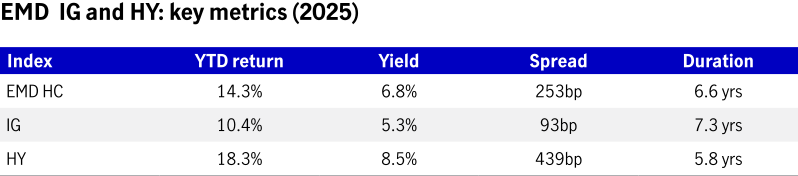
The risk profile of EMD HC is nuanced. While emerging markets can at times exhibit higher volatility than developed markets, the asset class has proven resilient, particularly during periods of acute market pressure and geopolitical stress. Sovereign credit ratings have been trading higher, finishing the year positively realizing 57 upward credit rating actions against 18 downgrades, excluding any credit rating outlook changes. The three-month moving average of positive to negative credit rating actions has been set to new highs, and the net cumulative actions stands at the least negative since COVID-19, as of the final quarter for the year.
Credit rating actions
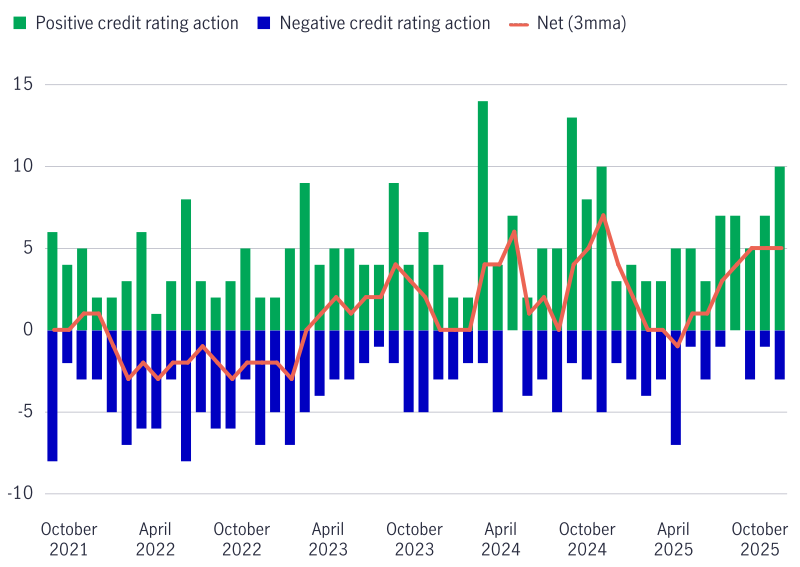
Subsequently, projected EM sovereign high-yield default rate for 2026 is projected to be stable at very low single digits propelled by overall sound economic growth, broadly contained inflationary dynamics and relatively sound fiscal and external balances. This broad investable universe allows investors to adjust risk, duration, and currency exposure to match specific portfolio objectives.
Furthermore, EMD technicals offer a further tailwind with strong net inflows and record high net issuance reflective of investor appetite further enhancing market liquidity with a yield pick up relative to developed markets manifesting a supportive backdrop.
Portfolio construction for pension plans
For defined benefit (DB) pension funds, EMD presents a compelling value proposition, particularly when leveraged through diversified, actively managed strategies that align with liability objectives. Despite a decrease over the past two decades, the allocation to domestic bonds has remained substantial for defined benefit pension plans. In 2004, domestic bonds constituted 82.5% of total bonds, while in 2024, this figure stood at 70.0%. Countries like Canada, the Netherlands, the UK, and the United States maintain the highest allocations to domestic bonds. Reallocating part of this existing bond allocation to EMD can offer defined benefit (DB) pension plans an opportunity to enhance yield and return potential, improve diversification benefits, and gain access to growth economies.
In addition, the balanced maturity structure of EMD supports both short-term tactical allocations and long-term strategic holdings. This flexibility makes it applicable to various pension schemes. For example, combining hard currency EMD with an average maturity of three to ten years, a currency hedging program in domestic currency, and a completion mandate in domestic bonds to achieve the desired target hedge ratio can provide significant benefits for defined benefit pension plans. This approach broadens the universe of bonds, enhances diversification, and offers the same level of coverage for liability risk.
Introducing EMD HC into a classic 60/40 portfolio
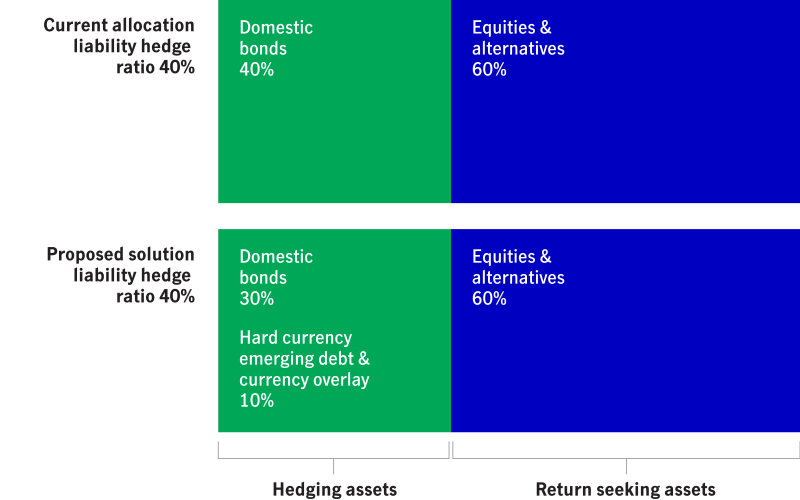
The balanced maturity structure of EMD HC also supports both short-term tactical allocations and long-term strategic holdings. This flexibility makes it applicable to various institutional schemes.
- Hard currency sovereign debt: Average maturity of 7–10 years
- Hard currency corporate debt: IG maturities up to 10+ years, HY maturities of 3–5 years
- Local currency debt: Typical maturities of 3–7 years
This maturity profile enables duration matching for DB plans and facilitates return-seeking tilts for defined contribution (DC) accumulation phases. For pension funds, EMD HC can act as a return enhancer and diversifier, often with a 2-5% weight in DC strategies during accumulation. In the decumulation phase, it can serve as a yield enhancer, with a typical allocation of around 2% focused on IG hard currency debt.
Efficient portfolio modeling, including efficient frontier analysis, consistently demonstrates that incorporating EMD HC into a multi-asset portfolio can enhance expected returns for a given level of risk.
Portfolio construction for insurers
EMD can significantly enhance insurance portfolios by boosting income and diversification without compromising balance sheet discipline. As insurers face the challenges of low yields in developed markets and increasing capital efficiency constraints, EMD offers an attractive yield premium. This improves portfolio return potential while maintaining public market liquidity and flexibility.
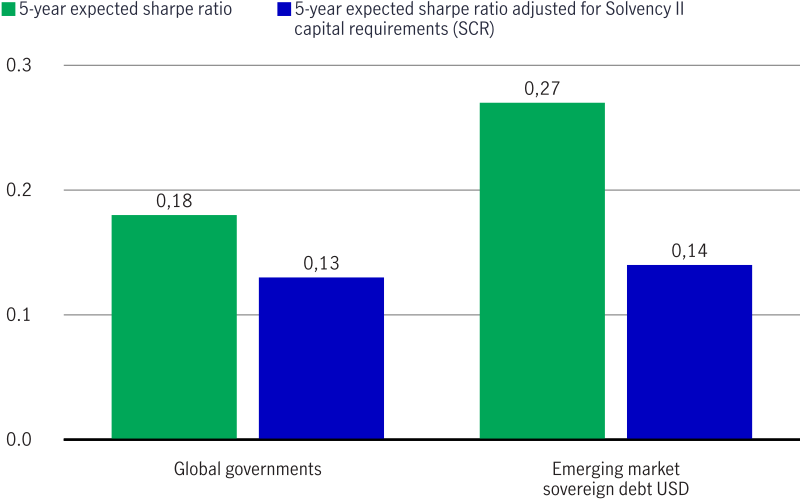
The evolving sovereign and corporate fundamentals in many emerging economies challenge outdated perceptions of risk. Active management allows insurers to optimize capital treatment, manage drawdowns, and align exposures with long-term liabilities. When integrated thoughtfully within a total portfolio framework, EMD can provide resilient income and differentiated return drivers that align well with insurers' long-term objectives. When comparing the performance of US dollar-denominated bonds1 from emerging market sovereign entities with public debt from investment-grade sovereign issuers2, EMD demonstrates compelling results on a return-adjusted basis. This remains true even after accounting for capital requirements.
EMD performance under EU Solvency II capital requirements
Investment styles and sustainability considerations
EMD HC accommodates multiple investment styles. A “buy and maintain” strategy focuses on stable income and duration matching, favoring IG hard-currency debt. In contrast, a total return approach employs active management to exploit idiosyncratic opportunities, tactical allocations to HY, and selective local currency exposure. Model portfolios can be tailored to meet scheme objectives, risk budgets, and regulatory requirements.
Thematic and sustainability-linked bonds and instruments are also increasingly prevalent in EMD, broadening the opportunity set and attracting dedicated capital. As EMs implement stronger governance, rising stars are emerging among both corporate and sovereign entities. This trend necessitates rigorous, issuer-specific due diligence focused on sustainability metrics, policy frameworks, and transparency.
The growth of EMD reflects stronger financial infrastructure and improved access to global capital. While deeper markets provide better access, they can also introduce new vulnerabilities. Elevated debt burdens in some EMs, a consequence of post-COVID borrowing and tighter global financial conditions, underscore the importance of credit differentiation and active management. Transparency is another critical factor. The existence of opaque bilateral lending, particularly from nontraditional creditors, highlights the need for forensic analysis in specific markets to fully understand an issuer’s debt profile.
An evolving asset class
EMD hard currency has established itself as a strategic allocation in the global fixed income market. Its evolution from a niche segment to a core asset class reflects the growing economic weight and policy maturity of emerging markets. With strong fundamentals, resilient credit quality, and an ever-expanding opportunity set, EMD HC is well-positioned to potentially enhance both return and diversification in institutional portfolios. Rigorous due diligence and active management are paramount to capturing the full potential of this dynamic asset class.
1 J.P. Morgan CEMBI Broad Diversified Core Index (CEMBI CORE). 2 ICE BofA Global Government Index.
Important disclosures
Important disclosures
Investing involves risks, including the potential loss of principal. Financial markets are volatile and can fluctuate significantly in response to company, industry, political, regulatory, market, or economic developments. The information provided does not take into account the suitability, investment objectives, financial situation, or particular needs of any specific person.
All overviews and commentary are intended to be general in nature and for current interest. While helpful, these overviews are no substitute for professional tax, investment or legal advice. Clients and prospects should seek professional advice for their particular situation. Neither Manulife Wealth and Asset Management, nor any of its affiliates or representatives (collectively “Manulife WAM”) is providing tax, investment or legal advice.
This material is intended for the exclusive use of recipients in jurisdictions who are allowed to receive the material under their applicable law. The opinions expressed are those of the author(s) and are subject to change without notice. Our investment teams may hold different views and make different investment decisions. These opinions may not necessarily reflect the views of Manulife WAM. The information and/or analysis contained in this material has been compiled or arrived at from sources believed to be reliable, but Manulife WAM does not make any representation as to their accuracy, correctness, usefulness, or completeness and does not accept liability for any loss arising from the use of the information and/or analysis contained. The information in this material may contain projections or other forward-looking statements regarding future events, targets, management discipline, or other expectations, and is only current as of the date indicated. The information in this document, including statements concerning financial market trends, are based on current market conditions, which will fluctuate and may be superseded by subsequent market events or for other reasons. Manulife WAM disclaims any responsibility to update such information.
Manulife WAM shall not assume any liability or responsibility for any direct or indirect loss or damage or any other consequence of any person acting or not acting in reliance on the information contained here. This material was prepared solely for informational purposes, does not constitute a recommendation, professional advice, an offer or an invitation by or on behalf of Manulife WAM to any person to buy or sell any security or adopt any investment approach, and is no indication of trading intent in any fund or account managed by Manulife WAM. No investment strategy or risk management technique can guarantee returns or eliminate risk in any market environment. Diversification or asset allocation doesn’t guarantee a profit or protect against the risk of loss in any market. Unless otherwise specified, all data is sourced from Manulife WAM. Past performance does not guarantee future results.
This material has not been reviewed by, and is not registered with, any securities or other regulatory authority, and may, where appropriate, be distributed by Manulife WAM and its subsidiaries and affiliates. Manulife WAM is the global investment, financial advice, and retirement plan services segment of Manulife Financial Corporation.
© 2026 by Manulife Wealth and Asset Management. All rights reserved. The statements and opinions expressed in this article are those of the author. Manulife WAM cannot guarantee the accuracy or completeness of any statements or data.