



AI and the global economy: into the great wide open
Artificial intelligence (AI) could have multiple profound impacts on the global economy, but many questions remain unanswered. Here, we discuss what the coming years might hold through a macroeconomic lens.

It’s difficult to talk about the macroeconomic landscape these days without the conversation eventually turning toward how artificial intelligence (AI) could influence—perhaps even reshape—the current paradigm. While there’s clearly a wide range of possible outcomes, our outlook explores AI’s likely impact on the global economy over the next few years, longer-term macro considerations, and some potential obstacles faced by the industry.
Short term: capex will be a major driver of growth
Fueled by expectations of significant productivity gains across industries and rapid user adoption, the boom in large language models (LLMs) since 2022 has sparked a robust capital expenditures (capex) cycle in the United States. This phenomenon has accelerated to the point where we estimate that investment in processing equipment and software—a proxy for overall AI spending—accounted for nearly a quarter of the nation’s annualized GDP growth in the first three quarters of 2025 (after adjusting for the large share of semiconductors that are imported). We think AI spending mostly explains the surprising resilience of the U.S. economy this year, despite heightened policy uncertainty and tariffs, and we expect it to continue for the next few years.
Over the next two years, AI-related investment looks set to proceed at warp speed. As of this writing, analysts forecast that the five largest U.S. cloud computing hyperscalers will spend over US$1 trillion on AI capex in 2026 and 2027. These investments are likely to include datacenters, graphics processing units (GPUs), dynamic random access memory (DRAM), and storage, in addition to microprocessor production capacity and actual AI software development (both in the U.S. and abroad). The $1 trillion figure could actually prove to be a conservative estimate, with new deals being announced almost daily and global players increasingly joining the AI race, especially in China.
AI capex looks poised to skyrocket over the next two years
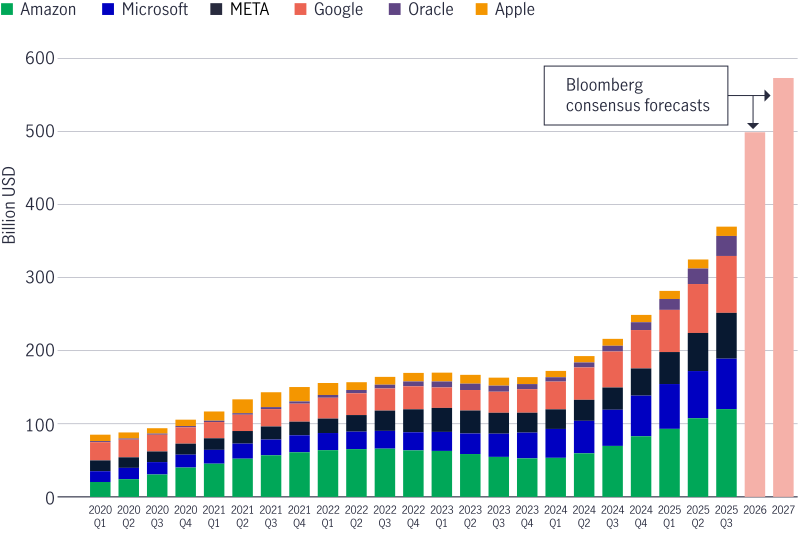
With this explosive growth comes rising concerns around overbuilding and creating excess capacity. However, we think four important factors mitigate this risk and support the AI infrastructure buildout, which should, in turn, continue to support global economic growth over the shorter term:
- The rate of AI adoption is quite rapid. Both consumers and businesses are rapidly adopting AI technologies, with demand for new computing models increasing by a factor of about 4.4x per year according to EpochAI. The faster AI becomes entrenched as a business tool, the sooner the technologies will begin to generate meaningful revenue for corporations. As a path to enhanced profitability emerges, the higher the likelihood that the AI infrastructure buildout will be sustainable.
- Spending is coming from profitable companies. Unlike debt-fueled bubbles of the past, today’s capex has so far been largely funded through companies’ retained earnings and free cash flows, helping to limit the risk of a deleveraging spiral spilling over to the broader economy. This trend could be starting to change, which is of little surprise given the sheer scale of the capital needed to sustain AI-related expansion in the coming years. Key industry players have recently announced debt financing for their upcoming infrastructure builds.
- Fiscal policy tailwinds may further boost AI spending. Fiscal policy in many countries could also serve as a strong tailwind over the next 12 months. Case in point: the expensing of capex in the United States under the One Big Beautiful Bill Act. Moreover, tariff exemptions for AI-related imports are saving firms billions of dollars, improving the economics of investing in technology.
- Monetary policy may provide another form of support. For example, we believe the U.S. Federal Reserve is likely to continue cutting interest rates into 2026, which should bolster U.S. capital investments in AI as financing costs drop off. Historically, several market corrections have coincided with rising rates, which tend to amplify stress on capital-heavy businesses.
Long term: there’s clear upside, but questions remain
Over the longer term, the economic benefits of these massive investments hinge on future productivity gains made possible by AI adoption. On that front, estimates vary greatly. Depending on assumptions about adoption rates, cost savings, and potential revenue generation, a Cognizant impact study conducted in partnership with Oxford Economics projects that activity in the AI space could lift U.S. GDP by between as little as 0.7% and as much as 6.0% over the next decade. Even just a median baseline impact of 2.5% would be materially additive to the long-term economic outlook.
AI’s potential impact on inflation is interesting. The primary near-term pressure point is energy. Indeed, data centers’ seemingly insatiable demand for energy strains power grids and drives electricity prices higher. In that context, data center energy efficiency (e.g., a colder climate to reduce cooling costs) and access to inexpensive power sources could become more important cost considerations. However, broad enhancements to productivity could prove deflationary.
Global electricity consumption is on the rise, driving energy prices higher
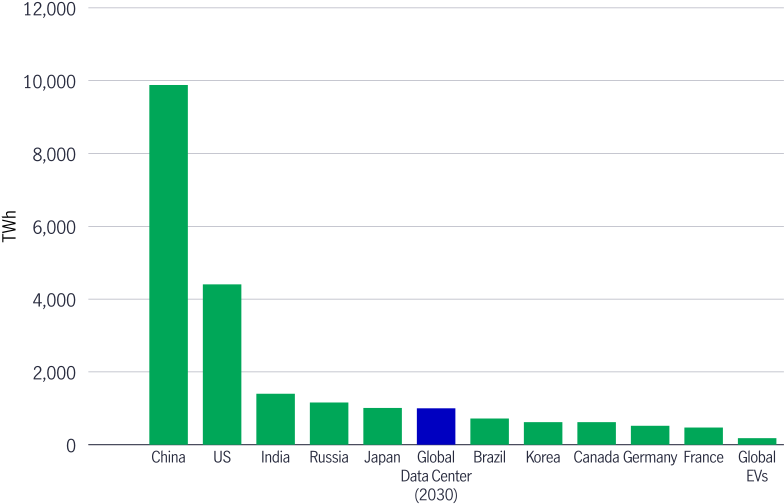
Taken together, the net long-term effects are likely to be slightly disinflationary, as the far-reaching benefits of innovation should outweigh issues surrounding energy scarcity. At the margin, lower inflation would favor slightly easier monetary policy, which would flow through to the rest of the yield curve. That said, the recent shift toward financing AI-related capex with debt could add to overall bond issuance and global supply, potentially increasing the cost of capital in certain areas.
The impact of AI on the labor market is also uncertain. There are currently plenty of anecdotes in circulation around how AI is rewriting job requirements in the technology space, but at the moment, evidence of broad-based AI-driven job losses is inconclusive. Over a longer period, however, we would expect a three-tiered effect on the labor market: 1) certain types of jobs will ultimately be replaced by AI technologies; 2) other jobs are likely to use AI to enhance productivity; 3) professions that don’t exist now could emerge as a result of evolving technology.
There are obstacles to overcome
Finally, looking ahead, the AI industry is not without potential risks and headwinds. To fully realize its long-term potential, we think the industry will have to overcome certain obstacles, such as:
- Energy bottlenecks. Power requirements for new AI models have doubled every year, and data centers globally already consume as much power as France or the United Kingdom. By 2030, usage could reach what Japan is using today. Energy is becoming a barrier to completing projects in a timely manner, as connection delays and transformer shortages are mounting. In response, many tech companies have started stockpiling their own energy supplies. Should this trend persist, energy infrastructure developments could guarantee ongoing power to the AI space without hurting other segments of the economy.
- Monetization. At the moment, LLMs’ subscription fees cover only a fraction of AI’s operating and capital expenditures. Over time, we think major players will require a positive return on their investments, which could rein in AI spending. Also, LLMs’ market structure doesn’t benefit from network effects the same way social media did, making it theoretically harder to extract subscriptions and add revenue streams. We think monetization implies expanding AI applications beyond LLMs to sectors like robotics and healthcare.
- Swift depreciation: GPUs and network equipment have relatively short lifecycles. Tech companies generally anticipate a hardware life of only around five years due to rapid technical innovation and high utilization rates. The challenge will be to implement a sustainably profitable business model, given the very high costs of maintaining cutting-edge datacenter capabilities.
Important disclosures
Important disclosures
This document contains forward-looking statements within the meaning of the "safe harbour" provisions of Canadian provincial securities laws and the U.S. Private Securities Litigation Reform Act of 1995 with respect to Manulife’s use of its digital capabilities, including AI-enabled tools, and the expected benefits it expects to realize with such tools, including with respect to outcomes for clients and partners. Although we believe that the expectations reflected in such forward-looking statements are reasonable, such statements involve risks and uncertainties, and undue reliance should not be placed on such statements. Certain material factors or assumptions are applied in making forward-looking statements, and actual results may differ materially from those expressed or implied in such statements. Important factors that could cause actual results to differ materially from expectations include but are not limited to general business and economic conditions; changes in laws and regulations with respect to the use of AI-enabled tools; our ability to execute our digital plans and to deploy future digital use cases; our ability to adapt products and services to the changing market; our ability to attract and retain key employees; and our ability to protect our intellectual property and exposure to claims of infringement from others. Additional information about material risk factors that could cause actual results to differ materially from expectations may be found in our most recent annual and interim reports and elsewhere in our filings with Canadian and U.S. securities regulators.
Investing involves risks, including the potential loss of principal. Financial markets are volatile and can fluctuate significantly in response to company, industry, political, regulatory, market, or economic developments. These risks are magnified for investments made in emerging markets. Currency risk is the risk that fluctuations in exchange rates may adversely affect the value of a portfolio’s investments.
The information provided does not take into account the suitability, investment objectives, financial situation, or particular needs of any specific person. You should consider the suitability of any type of investment for your circumstances and, if necessary, seek professional advice.
This material is intended for the exclusive use of recipients in jurisdictions who are allowed to receive the material under their applicable law. The opinions expressed are those of the author(s) and are subject to change without notice. Our investment teams may hold different views and make different investment decisions. These opinions may not necessarily reflect the views of Manulife Investment Management or its affiliates. The information and/or analysis contained in this material has been compiled or arrived at from sources believed to be reliable, but Manulife Investment Management does not make any representation as to their accuracy, correctness, usefulness, or completeness and does not accept liability for any loss arising from the use of the information and/or analysis contained. The information in this material may contain projections or other forward-looking statements regarding future events, targets, management discipline, or other expectations, and is only current as of the date indicated. The information in this document, including statements concerning financial market trends, are based on current market conditions, which will fluctuate and may be superseded by subsequent market events or for other reasons. Manulife Investment Management disclaims any responsibility to update such information.
Neither Manulife Investment Management or its affiliates, nor any of their directors, officers or employees shall assume any liability or responsibility for any direct or indirect loss or damage or any other consequence of any person acting or not acting in reliance on the information contained here. All overviews and commentary are intended to be general in nature and for current interest. While helpful, these overviews are no substitute for professional tax, investment or legal advice. Clients should seek professional advice for their particular situation. Neither Manulife, Manulife Investment Management, nor any of their affiliates or representatives is providing tax, investment or legal advice. This material was prepared solely for informational purposes, does not constitute a recommendation, professional advice, an offer or an invitation by or on behalf of Manulife Investment Management to any person to buy or sell any security or adopt any investment strategy, and is no indication of trading intent in any fund or account managed by Manulife Investment Management. No investment strategy or risk management technique can guarantee returns or eliminate risk in any market environment. Diversification or asset allocation does not guarantee a profit or protect against the risk of loss in any market. Unless otherwise specified, all data is sourced from Manulife Investment Management. Past performance does not guarantee future results.
About Manulife Wealth & Asset Management
As part of Manulife Financial Corporation, Manulife Wealth & Asset Management provides global investment, financial advice, and retirement plan services to 19 million individuals, institutions, and retirement plan members worldwide. Our mission is to make decisions easier and lives better by empowering people today to invest for a better tomorrow. As a committed partner to our clients and as a responsible steward of investor capital, we offer a heritage of risk management, deep expertise across public and private markets, and comprehensive retirement plan services. We seek to provide better investment and impact outcomes and to help people confidently save and invest for a more secure financial future. Not all offerings are available in all jurisdictions. For additional information, please visit manulifeim.com.
This material has not been reviewed by, is not registered with any securities or other regulatory authority, and may, where appropriate, be distributed by the following Manulife entities in their respective jurisdictions. Additional information about Manulife Investment Management may be found at manulifeim.com/institutional
Australia: Manulife Investment Management Timberland and Agriculture (Australasia) Pty Ltd, Manulife Investment Management (Hong Kong) Limited. Canada: Manulife Investment Management Limited, Manulife Investment Management Distributors Inc., Manulife Investment Management (North America) Limited, Manulife Investment Management Private Markets (Canada) Corp. Mainland China: Manulife Overseas Investment Fund Management (Shanghai) Limited Company. European Economic Area Manulife Investment Management (Ireland) Ltd. which is authorised and regulated by the Central Bank of Ireland Hong Kong: Manulife Investment Management (Hong Kong) Limited. Indonesia: PT Manulife Aset Manajemen Indonesia. Japan: Manulife Investment Management (Japan) Limited. Malaysia: Manulife Investment Management (M) Berhad 200801033087 (834424-U) Philippines: Manulife Investment Management and Trust Corporation. Singapore: Manulife Investment Management (Singapore) Pte. Ltd. (Company Registration No. 200709952G) South Korea: Manulife Investment Management (Hong Kong) Limited. Switzerland: Manulife IM (Switzerland) LLC. Taiwan: Manulife Investment Management (Taiwan) Co. Ltd. United Kingdom: Manulife Investment Management (Europe) Ltd. which is authorised and regulated by the Financial Conduct Authority United States: John Hancock Investment Management LLC, Manulife Investment Management (US) LLC, Manulife Investment Management Private Markets (US) LLC and Manulife Investment Management Timberland and Agriculture Inc. Vietnam: Manulife Investment Fund Management (Vietnam) Company Limited.
Manulife, Manulife Investment Management, Stylized M Design, and Manulife Investment Management & Stylized M Design are trademarks of The Manufacturers Life Insurance Company and are used by it, and by its affiliates under license.
4984640

Alex Grassino,
Global Chief Economist, Multi-Asset Solutions, Manulife Investment Management
Manulife Investment Management
Read bio
Dominique Lapointe, CFA,
Senior Global Macro Strategist, Manulife Investment Management
Manulife Investment Management
Read bio
Hugo Bélanger,
Senior Global Macro Analyst, Multi-Asset Solutions Team, Manulife Investment Management
Manulife Investment Management
Read bio