



Investing in AI: navigating the froth and fundamentals in a fast-moving world
AI has rapidly become a defining investment theme, offering the potential to reshape industries, drive productivity, and unlock new sources of growth. Its transformative impact is creating new possibilities for investors to capture value in a changing market. In this article, we explore how AI is reshaping both the opportunities and the challenges we face as stewards of capital.

Few themes have proven as pervasive and transformative as the rise of artificial intelligence (AI). At Manulife Wealth & Asset Management, our dual focus on rigorous bottom-up stock selection and sophisticated top-down asset allocation leaves us well positioned to capitalize on this secular revolution. In this article, Colin Purdie, chief investment officer for public markets, and Nate Thooft, our chief investment officer for our Multi-Asset Solutions Team, explore how AI is reshaping both the opportunities and the challenges we face as stewards of capital.
AI’s dual impact: bottom-up and top-down perspectives
Our investment teams span both bottom-up stock selectors and top-down asset allocators, and AI’s influence is felt acutely in both domains. From the equity perspective, the opportunity set is vast and evolving rapidly. The winners and losers in this space are being determined in real time, and the pace of change is relentless.
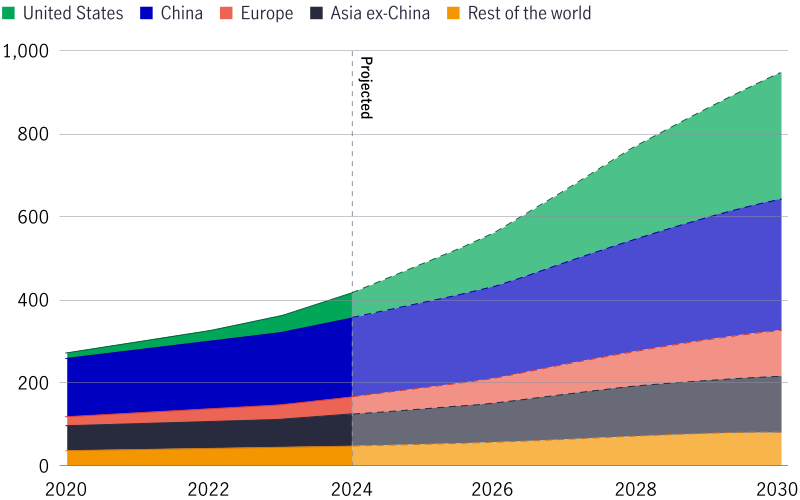
The companies benefiting most to date are those that we describe as enablers: companies capturing the massive capital expenditures currently being deployed globally to build out AI infrastructure. These aren’t limited to traditional technology firms; utility companies and manufacturers supplying critical components have also emerged as surprise beneficiaries, driven by surging demand for power and new infrastructure.
Data centre electricity consumption by region, base case, 2020–2030
However, we believe the companies poised to leverage AI to enhance scale, efficiency, and cost reduction—the beneficiaries—are currently being overlooked or, in some cases, penalized. We expect this dynamic will shift as the significant levels of capital expenditure into AI begin bearing fruit and the technology becomes more embedded in improving operational processes. For instance, financial firms could benefit from faster processing times, while healthcare companies may see advancements in clinical diagnostics and accelerated drug development. As these applications mature, we anticipate greater investor attention and rewards for these beneficiaries.
We’re not convinced this shift will happen across the board, however, and certain sectors are facing existential challenges. The software industry, for example, is confronting fears that AI could erode the value of recurring subscription models. As AI becomes capable of coding and building software autonomously, less innovative companies may find themselves bypassed by clients who can generate their own solutions. This dynamic underscores the need for careful stock selection and ongoing vigilance as we navigate the shifting terrain.
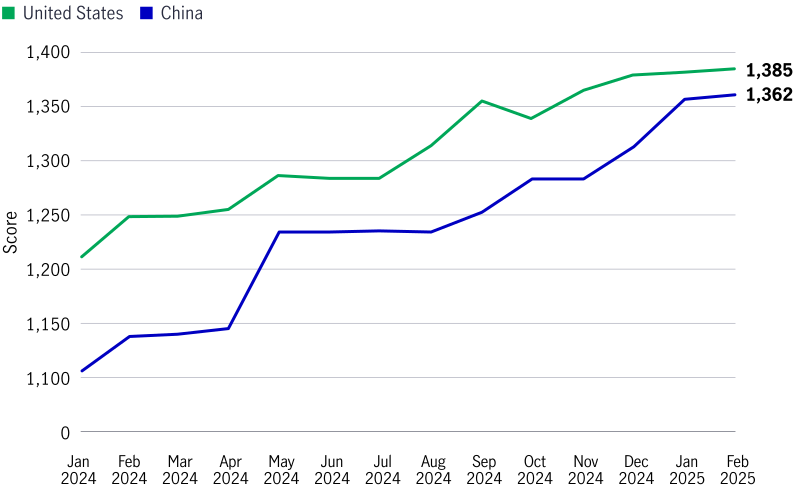
From a top-down perspective, our asset allocation approach is increasingly thematic. For years, we’ve maintained overweight positions in technology, and this has served our portfolios well. But AI’s reach extends beyond sectoral boundaries; it’s a force reshaping entire economies. The United States, with its deep AI ecosystem, remains a focal point, yet we also see significant opportunity in China, where a parallel universe of AI development is unfolding amid global bifurcation and deglobalization. This fragmentation is creating two distinct worlds of AI innovation—one in the East and one in the West—and both merit close attention.
Valuations: froth, fundamentals, and finding value
Market chatter around AI often centers on valuations, with questions focused on whether we’re witnessing another tech bubble or whether the secular growth we’re seeing is justified. At Manulife Wealth & Asset Management, we approach this question with a healthy dose of skepticism and rigor. While there’s undeniably some froth in the market, with companies enjoying outsize performance simply by associating themselves with AI, when we drill down into the fundamentals, the comparison to the dot-com era falls short.
The leading AI beneficiaries today aren’t speculative ventures with unproven business models. Rather, the majority are established firms with robust earnings, high and stable margins, and defensible competitive moats. Their ability to scale and their barriers to entry are substantial, and their earnings expectations are rising, not falling. We believe many of these companies deserve their higher multiples, and the sustainability of their business models is evident in their financial performance.
That said, we remain vigilant. Not all AI-linked companies are created equal, and pockets of overvaluation do exist—particularly among smaller private equity names riding the wave of news-driven enthusiasm. Our task is to separate signal from noise, identifying those firms with genuine, durable exposure to AI-driven growth.
AI across public and private markets
Our approach to expressing AI exposure in portfolios is multifaceted. On the public side, thematic investing remains a cornerstone. We ensure our portfolios are positioned to capture the productivity enhancements that AI promises, not only through direct technology holdings but also through ancillary sectors such as utilities and industrials. The utility sector, in particular, has seen unexpected upside as the energy demands of AI infrastructure soar.
On the private side, we see compelling opportunities in infrastructure, digitalization, and utilities. The limited supply and high demand for these assets make them attractive diversifiers, and their role in enabling the AI revolution cannot be overstated. Private assets allow us to tap into trends that may be less accessible in public markets, providing a critical complement to our overall exposure.
Geographically, our allocations are informed by the composition of local indexes and the degree of AI integration within national economies. The United States may be dominant today, but China’s rapid progress and the inevitable emergence of two separate AI ecosystems already call for a global lens. As deglobalization accelerates, understanding these dynamics is essential for effective asset allocation.
Performance of top United States vs. Chinese models on LMSYS Chatbot Arena
The macroeconomic implications of AI
AI’s impact isn’t confined to individual companies or sectors—it’s reshaping the macroeconomic environment itself. Recent data suggests that AI could drive a 15 percentage point increase in global GDP over the coming decade. Even a fractional uptick in growth could have outsize implications for capital market assumptions, earnings growth, and ultimately, portfolio returns.
This productivity enhancement is particularly valuable in today’s slow-growth world. As investors, we’re acutely aware that economic growth is a primary input into our models for asset class returns. The prospect of AI-driven acceleration in output and efficiency is a key driver of our constructive outlook on equities and related asset classes.
AI in the investment process: augmentation, not replacement
Perhaps most importantly, AI is transforming our investment process itself. Our goal isn’t to replace human judgment, but to augment it—to enable our analysts and portfolio managers to make informed decisions faster and with greater insight. The volume of data available to us is expanding exponentially, and AI tools allow us to process, analyze, and interpret this information at unprecedented scale and speed.
Yet the human element remains central. Markets are inherently irrational at times, and the value we add as active managers derives from our ability to apply judgment, intuition, and experience. AI is a powerful tool, but it’s not a substitute for human decision-making. Our clients expect and deserve the insight and stewardship that only seasoned professionals can offer.
As AI takes on more of the data-intensive tasks, our portfolio managers and analysts are freed to focus on higher-value activities: uncovering new opportunities, deepening their understanding of complex markets, and refining their investment theses. The future is one of humans plus AI, not humans versus AI.
Evolving roles and enduring principles
As we integrate AI more fully into our investment processes, the nature of our work will likely evolve. The core principles of rigorous analysis, disciplined risk management, and client-centric decision-making will remain unchanged. What will change, however, is how we execute these principles: with greater speed, depth, and breadth, enabled by AI.
We’re excited about the opportunities ahead. The AI revolution isn’t a passing fad; it’s a secular shift that we believe will define the next decade of investing. By embracing its potential while maintaining our commitment to human judgment and rigorous process, we believe we’re well positioned to deliver superior outcomes for our clients.
Important disclosures
Important disclosures
Investing involves risks, including the potential loss of principal. Financial markets are volatile and can fluctuate significantly in response to company, industry, political, regulatory, market, or economic developments. These risks are magnified for investments made in emerging markets. Currency risk is the risk that fluctuations in exchange rates may adversely affect the value of a portfolio’s investments.
The information provided does not take into account the suitability, investment objectives, financial situation, or particular needs of any specific person. You should consider the suitability of any type of investment for your circumstances and, if necessary, seek professional advice.
This material is intended for the exclusive use of recipients in jurisdictions who are allowed to receive the material under their applicable law. The opinions expressed are those of the author(s) and are subject to change without notice. Our investment teams may hold different views and make different investment decisions. These opinions may not necessarily reflect the views of Manulife Investment Management or its affiliates. The information and/or analysis contained in this material has been compiled or arrived at from sources believed to be reliable, but Manulife Investment Management does not make any representation as to their accuracy, correctness, usefulness, or completeness and does not accept liability for any loss arising from the use of the information and/or analysis contained. The information in this material may contain projections or other forward-looking statements regarding future events, targets, management discipline, or other expectations, and is only current as of the date indicated. The information in this document, including statements concerning financial market trends, are based on current market conditions, which will fluctuate and may be superseded by subsequent market events or for other reasons. Manulife Investment Management disclaims any responsibility to update such information.
Neither Manulife Investment Management or its affiliates, nor any of their directors, officers or employees shall assume any liability or responsibility for any direct or indirect loss or damage or any other consequence of any person acting or not acting in reliance on the information contained here. All overviews and commentary are intended to be general in nature and for current interest. While helpful, these overviews are no substitute for professional tax, investment or legal advice. Clients should seek professional advice for their particular situation. Neither Manulife, Manulife Investment Management, nor any of their affiliates or representatives is providing tax, investment or legal advice. This material was prepared solely for informational purposes, does not constitute a recommendation, professional advice, an offer or an invitation by or on behalf of Manulife Investment Management to any person to buy or sell any security or adopt any investment strategy, and is no indication of trading intent in any fund or account managed by Manulife Investment Management. No investment strategy or risk management technique can guarantee returns or eliminate risk in any market environment. Diversification or asset allocation does not guarantee a profit or protect against the risk of loss in any market. Unless otherwise specified, all data is sourced from Manulife Investment Management. Past performance does not guarantee future results.
Caution regarding forward-looking statements
This document contains forward-looking statements within the meaning of the "safe harbour" provisions of Canadian provincial securities laws and the U.S. Private Securities Litigation Reform Act of 1995 with respect to Manulife’s use of its digital capabilities, including AI-enabled tools, and the expected benefits it expects to realize with such tools, including with respect to outcomes for clients and partners. Although we believe that the expectations reflected in such forward-looking statements are reasonable, such statements involve risks and uncertainties, and undue reliance should not be placed on such statements. Certain material factors or assumptions are applied in making forward-looking statements, and actual results may differ materially from those expressed or implied in such statements. Important factors that could cause actual results to differ materially from expectations include but are not limited to general business and economic conditions; changes in laws and regulations with respect to the use of AI-enabled tools; our ability to execute our digital plans and to deploy future digital use cases; our ability to adapt products and services to the changing market; our ability to attract and retain key employees; and our ability to protect our intellectual property and exposure to claims of infringement from others. Additional information about material risk factors that could cause actual results to differ materially from expectations may be found in our most recent annual and interim reports and elsewhere in our filings with Canadian and U.S. securities regulators.
5006172 12/25

Colin Purdie, CFA,
Global Chief Investment Officer, Public Markets
Manulife Investment Management
Read bio
Nathan W. Thooft, CFA,
CIO, Multi-Asset Solutions Team, Global Equities
Manulife Investment Management
Read bio