



Asset allocation views: building resilience through uncertainty
With early 2026 optimism giving way to geopolitical-driven volatility, our Q2 outlook emphasizes resilient diversification, valuation discipline, and balanced positioning.

2026 began with a constructive tone—risk appetite was firm, non-U.S. equities were outperforming, and precious metals were showing strong momentum, supported by earnings that were largely holding up. That backdrop shifted meaningfully in late February as conflict in the Middle East intensified and markets were forced to quickly reprice risk. Oil prices surged, inflation concerns re-emerged, and volatility across asset classes picked up, leaving multiple global equity markets trading in or near correction territory.
In environments like this, where the range of plausible outcomes is wide and forecasting precision is limited, we believe it’s more productive to focus on durable investment themes and portfolio construction decisions designed to remain resilient across a range of outcomes. In our view, that means staying valuation-aware, avoiding overly concentrated exposures, and rethinking portfolio diversification with a broader tool kit.
Positioning for what’s next
Despite a still-supportive macro backdrop for risk assets—underpinned by steady growth and robust earnings trends—the balance of risks has become more complex. Elevated valuations in parts of the market, renewed inflation sensitivity through energy, and persistent geopolitical uncertainty reinforce the need for disciplined risk management and diversified sources of return.
In our view, these are the key themes for Q2 2026:
- Middle East conflict: energy risk and macro uncertainty
Forecasting the Middle East conflict is highly uncertain. We assess it through time, infrastructure damage, and escalation. The conflict has lasted longer than expected, with impacts starting to show in inflation data. Damage so far seems reversible, so markets still view disruptions as temporary. Growth and inflation effects are likely to hit emerging markets hardest, Europe next, and North America least; central banks are increasingly hawkish outside North America. - AI: bubble or build-out?
We don’t see AI behaving like a classic bubble. The narrative has shifted from hype to large-scale real-economy investment in chips, data centers, and power—spanning semiconductors, cooling, and grid infrastructure. Leadership is also becoming more selective, raising the premium on earnings delivery, capital discipline, and valuation awareness. We favor diversified exposure across both AI enablers and beneficiaries. - Diversification isn’t dead: a smarter tool kit for resilience
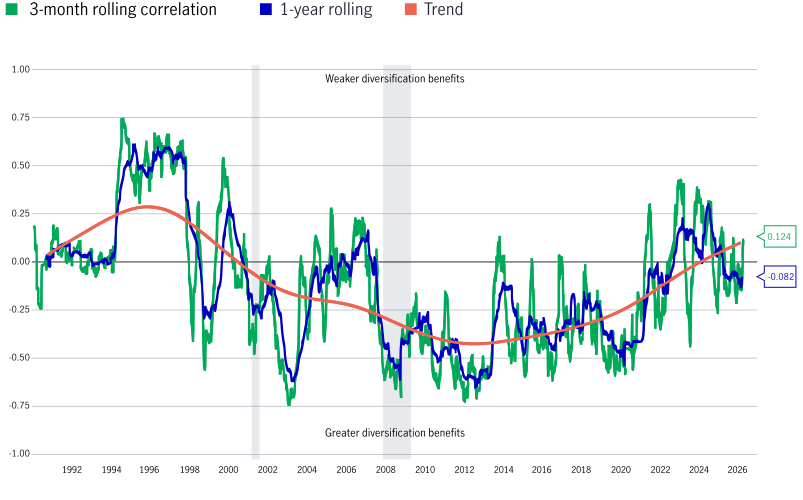
Traditional stock/bond diversification has been less reliable when inflation surprises or real rates swing—something recent energy-driven inflation concerns have highlighted. We think a broader tool kit matters more, including commodities (precious and base metals), income-oriented real assets, and liquid alternatives that may offer differentiated sources of real return beyond equity beta.
U.S. stock/bond correlation
Portfolio positioning highlights
Overall, we remain modestly overweight equities—earnings are holding up, and global growth is steady, with AI investment supporting parts of the market. But with uncertainty higher and valuations stretched, we’re emphasizing balance and avoiding concentration.
Regionally, we’ve moved U.S. equities to neutral on valuation and prefer a barbell of quality growth and cyclical/value exposure. We see more compelling opportunities outside the United States, and have upgraded Canada, emerging markets, and Japan to overweight, while keeping Europe ex-UK neutral amid the mix of better valuations and elevated geopolitical/energy risks. We also remain overweight Asia-Pacific ex-Japan, supported by resilient growth and AI-linked supply chains.
We’re leaning more on diversifiers too: Infrastructure equities are overweight for income and inflation resilience, and we remain overweight commodities, especially base metals such as aluminum, with gold as a long-term diversifier.
In fixed income, we stay underweight and prefer shorter duration. With tight credit spreads, we’re neutral on U.S. high yield, prefer Asia high yield, and remain overweight EM debt, tilting to local currency on expectations of a softer U.S. dollar.
For more details, read the latest asset allocation views from our Multi-Asset Solutions Team.
Important disclosures
Important disclosures
Investing involves risks, including the potential loss of principal. Financial markets are volatile and can fluctuate significantly in response to company, industry, political, regulatory, market, or economic developments. The information provided does not take into account the suitability, investment objectives, financial situation, or particular needs of any specific person.
All overviews and commentary are intended to be general in nature and for current interest. While helpful, these overviews are no substitute for professional tax, investment or legal advice. Clients and prospects should seek professional advice for their particular situation. Neither Manulife Wealth and Asset Management, nor any of its affiliates or representatives (collectively “Manulife WAM”) is providing tax, investment or legal advice.
This material is intended for the exclusive use of recipients in jurisdictions who are allowed to receive the material under their applicable law. The opinions expressed are those of the author(s) and are subject to change without notice. Our investment teams may hold different views and make different investment decisions. These opinions may not necessarily reflect the views of Manulife WAM. The information and/or analysis contained in this material has been compiled or arrived at from sources believed to be reliable, but Manulife WAM does not make any representation as to their accuracy, correctness, usefulness, or completeness and does not accept liability for any loss arising from the use of the information and/or analysis contained. The information in this material may contain projections or other forward-looking statements regarding future events, targets, management discipline, or other expectations, and is only current as of the date indicated. The information in this document, including statements concerning financial market trends, are based on current market conditions, which will fluctuate and may be superseded by subsequent market events or for other reasons. Manulife WAM disclaims any responsibility to update such information.
Manulife WAM shall not assume any liability or responsibility for any direct or indirect loss or damage or any other consequence of any person acting or not acting in reliance on the information contained here. This material was prepared solely for informational purposes, does not constitute a recommendation, professional advice, an offer or an invitation by or on behalf of Manulife WAM to any person to buy or sell any security or adopt any investment approach, and is no indication of trading intent in any fund or account managed by Manulife WAM. No investment strategy or risk management technique can guarantee returns or eliminate risk in any market environment. Diversification or asset allocation doesn’t guarantee a profit or protect against the risk of loss in any market. Unless otherwise specified, all data is sourced from Manulife WAM. Past performance does not guarantee future results.
This material has not been reviewed by, and is not registered with, any securities or other regulatory authority, and may, where appropriate, be distributed by Manulife WAM and its subsidiaries and affiliates. Manulife WAM is the global investment, financial advice, and retirement plan services segment of Manulife Financial Corporation.
© 2026 by Manulife Wealth and Asset Management. All rights reserved. The statements and opinions expressed in this article are those of the author. Manulife WAM cannot guarantee the accuracy or completeness of any statements or data.