



Realigning the approach to diversification in today’s complex landscape
The old idea of diversification—owning a little of a lot—is outdated. Today, it’s about focusing on resilience across asset classes, factors, and risk exposures to thrive in a world defined by complexity, speed, massive data quantities, and interconnection.

Diversification was once a straightforward concept: own a varied basket of local or U.S. equities, sprinkle in some fixed-income exposure, and balance risks. While this traditional approach is still common in the United States and Canada, market realities are forcing investors to reconsider. As markets have evolved, marked by rapid technological change, global interconnectedness, and unpredictable risks, the old approach is no longer enough.
Elevated valuations in tech and AI stocks, resulting in concentration among a few stocks, were the key themes of 2025. The bond market, too, had a volatile year, and further interest rate volatility could influence bond prices and returns. To thrive in today’s landscape, investors should consider realigning their diversification strategies to focus on resilience across asset classes, factors, and risk exposures, and avoid an overreliance on simple asset class categorization as a means of diversification. It’s less about owning a lot, and more about being intentional with what you own—and why.
What does diversification mean in today’s landscape?
Diversification is no longer just about balancing stocks and bonds. In an era defined by tech disruption, geopolitical shifts, and complex risks, modern portfolio strategy requires investors to consider additional factors.
- Broader diversification across assets: A portfolio may consist of private markets, real assets, alternatives, and select global opportunities of value, alongside traditional domestic investments. This broader approach can help mitigate correlation risks and potentially offer additional diversification benefits, especially in volatile market environments.
- Smarter global exposure: Identifying and capitalizing on opportunities across diverse countries and regions, as pockets of global opportunities arise, supported by improving macroeconomic trends and favourable policies. However, investors must keep a keen eye on policy divergence and local/geopolitical risks.
- Risk-focused strategies: Proactively managing interest rate, inflation, and liquidity risks rather than relying on historical correlations as these factors continue to evolve with speed and complexity.
- Scenario planning and stress testing: Modeling worst-case scenarios and not just relying on past data to help prepare for tail events and market shocks.
- Time horizon and liquidity considerations: With longer lifespans and evolving retirement needs, investors must ensure their portfolios match liquidity profiles and future obligations. This can help ensure resilience across varying market conditions.
Why diversification is crucial
A few successes with a simple investment strategy can give investors a false sense of security, making them less likely to prepare for periods of unexpected volatility. It’s important not to underestimate the risks that can arise when a thoughtful and proactive approach to diversification is neglected. Among these risks are:
1 Rising correlations in risk-off events
During risk-off events, investors tend to rush to sell risky assets and move into safe haven assets. This can create simultaneous declines across asset classes as rising correlations temporarily undermine diversification benefits.
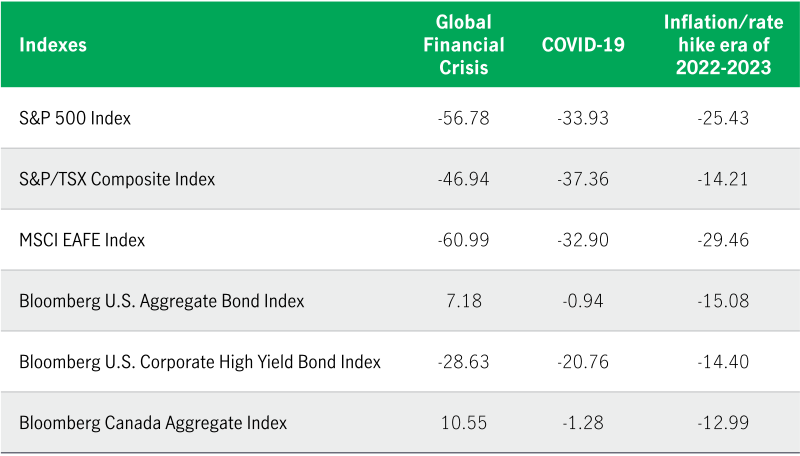
For example, during the 2022–2023 era of interest rate hikes, both bonds and stocks suffered as yields spiked. Similarly, events like the Global Financial Crisis of 2008, the COVID-19 market crash in 2020, and the banking turmoil in 2023 triggered broad-based selloffs, increasing correlations and collapsing diversification benefits.
Asset class performance during risk-off events
2 Liquidity mismatches
Illiquid allocations can amplify stress when liquidity is needed most. Diversification isn’t just about return streams—it’s about balancing liquidity profiles to meet obligations and avoid forced sales. Even assets that are typically considered liquid can, at times, become illiquid or see transaction costs rise significantly.
For instance, during the COVID-19 market crash of 2020, U.S. Treasury yields spiked for a period as liquidity dried up. High-yield bonds have had several events over the past couple of decades where liquidity became thin during risk-off events due to dealers’ unwillingness to hold inventory and sellers’ unwillingness to accept the gap in bid/ask spreads.
Rebalancing and staying resilient
Ultimately, diversification is about building resilience across asset classes, risk exposures, and time horizons. By avoiding common pitfalls, embracing adaptive strategies, and maintaining discipline, investors can position themselves to weather what the future holds.
The most detrimental mistake investors can make is overreacting to market triggers by selling too quickly, buying too soon, attempting to time the market, or panicking during risk events.
The key is to adopt a disciplined approach and rebalance as necessary, whether quarterly, semiannual, annually, or dynamically. In our view, the best practice is to use a threshold-based approach with a dynamic time horizon, rebalancing when allocations drift beyond set bands, and utilizing major market moves as catalysts to revisit allocations.
Lastly, participating in annual reviews to ensure that target allocations still align with risk tolerance, lifestyle, and goals can help prepare for what’s to come.
Index definitions
Index definitions
S&P 500 Index
The S&P 500 Index tracks the performance of 500 of the largest companies in the United States. It is not possible to invest directly in an index.
S&P/TSX Composite Index
The S&P/TSX Composite Index is the benchmark Canadian index that tracks the performance of companies listed on the Toronto Stock Exchange (TSX). It is not possible to invest directly in an index.
MSCI EAFE Index
The MSCI Europe, Australasia, and Far East (EAFE) Index tracks the performance of large- and mid-cap stocks of companies in those regions. It is not possible to invest directly in an index.
Bloomberg U.S. Aggregate Bond Index
The Bloomberg U.S. Aggregate Bond Index tracks the performance of U.S. investment-grade bonds in government, asset-backed, and corporate debt markets. It is not possible to invest directly in an index.
Bloomberg U.S. Corporate High Yield Bond Index
The Bloomberg U.S. Corporate High Yield (HY) Bond Index tracks the performance of the U.S. dollar-denominated, HY, fixed rate corporate bond market. It is not possible to invest directly in an index.
Bloomberg Canada Aggregate Index
The Bloomberg Canada Aggregate Index measures the investment grade, Canadian dollar-denominated, fixed rate, taxable bond market. It is not possible to invest directly in an index.
Important disclosures
Important disclosures
Investing involves risks, including the potential loss of principal. Financial markets are volatile and can fluctuate significantly in response to company, industry, political, regulatory, market, or economic developments. The information provided does not take into account the suitability, investment objectives, financial situation, or particular needs of any specific person.
All overviews and commentary are intended to be general in nature and for current interest. While helpful, these overviews are no substitute for professional tax, investment or legal advice. Clients and prospects should seek professional advice for their particular situation. Neither Manulife Wealth and Asset Management, nor any of its affiliates or representatives (collectively “Manulife WAM”) is providing tax, investment or legal advice.
This material is intended for the exclusive use of recipients in jurisdictions who are allowed to receive the material under their applicable law. The opinions expressed are those of the author(s) and are subject to change without notice. Our investment teams may hold different views and make different investment decisions. These opinions may not necessarily reflect the views of Manulife WAM. The information and/or analysis contained in this material has been compiled or arrived at from sources believed to be reliable, but Manulife WAM does not make any representation as to their accuracy, correctness, usefulness, or completeness and does not accept liability for any loss arising from the use of the information and/or analysis contained. The information in this material may contain projections or other forward-looking statements regarding future events, targets, management discipline, or other expectations, and is only current as of the date indicated. The information in this document, including statements concerning financial market trends, are based on current market conditions, which will fluctuate and may be superseded by subsequent market events or for other reasons. Manulife WAM disclaims any responsibility to update such information.
Manulife WAM shall not assume any liability or responsibility for any direct or indirect loss or damage or any other consequence of any person acting or not acting in reliance on the information contained here. This material was prepared solely for informational purposes, does not constitute a recommendation, professional advice, an offer or an invitation by or on behalf of Manulife WAM to any person to buy or sell any security or adopt any investment approach, and is no indication of trading intent in any fund or account managed by Manulife WAM. No investment strategy or risk management technique can guarantee returns or eliminate risk in any market environment. Diversification or asset allocation doesn’t guarantee a profit or protect against the risk of loss in any market. Unless otherwise specified, all data is sourced from Manulife WAM. Past performance does not guarantee future results.
This material has not been reviewed by, and is not registered with, any securities or other regulatory authority, and may, where appropriate, be distributed by Manulife WAM and its subsidiaries and affiliates. Manulife WAM is the global investment, financial advice, and retirement plan services segment of Manulife Financial Corporation.
© 2026 by Manulife Wealth and Asset Management. All rights reserved. The statements and opinions expressed in this article are those of the author. Manulife WAM cannot guarantee the accuracy or completeness of any statements or data.
5141538 2/26