



Asset allocation ETFs: here’s why “all-in-one” isn’t one-size-fits-all
As ETFs continue to gain momentum, advisors and investors are gravitating toward solutions that simplify the client experience while keeping total costs in mind. Here’s what’s driving the shift toward asset allocation ETFs, also known as all-in-one ETFs, and what to consider before using them in a portfolio.

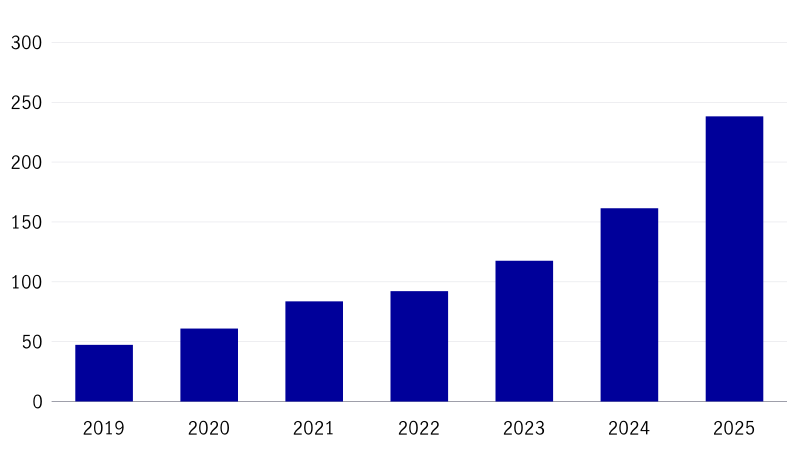
Active ETFs have quickly become a core part of how many investors build portfolios, and this shift has been anything but subtle. Since 2019, active ETF assets in Canada have grown rapidly, and their share of total ETF assets under management has risen from 23.1% to 32.4%.1
Active ETF assets under management in Canada have grown exponentially over the past decade
Active ETF assets, CAD$ billions
Behind those numbers is a simple reality: investors still want active decision-making, but they also want the ETF wrapper for its liquidity, tax efficiency, and ability to provide a clearer sense of what they own.
Just as importantly, costs have been a significant driver of this adoption. On average, active ETFs have been less expensive than comparable active mutual funds. With Total Cost Reporting (TCR) now in place, we expect the shift toward ETFs, and more specifically active ETFs, to continue.
Why are investors choosing asset allocation ETFs?
With broader fee transparency now in effect, clients are paying closer attention to what they own, what it costs, and how it’s being managed. That’s one reason asset allocation ETFs have become so popular in Canada: they're built to deliver a diversified portfolio—often using underlying ETFs—in a single, easy-to-implement ticker.
That simplicity has resonated. In 2025, asset allocation ETFs took in $22.7 billion in net inflows, more than double the prior year’s pace.2 For many clients, these funds provide a straightforward answer to a complicated question: “How do I invest globally, stay diversified, and avoid making emotional changes?”
For many advisors, it’s also a workflow win: less time managing moving parts and more time to spend on higher-value work, such as financial planning, tax management, and client coaching.
The value of combining ETFs and asset allocation portfolios
An asset allocation ETF helps advisors translate a client’s risk profile into a diversified portfolio that can be implemented consistently and monitored with confidence. And because these solutions are often built using underlying ETFs, they can leverage the powerful synergies between ETFs and asset allocation portfolios.
1) Tax efficiency
Tax outcomes often depend on how frequently a portfolio is changed and maintained over time. Asset allocation ETFs can streamline implementation by consolidating exposures into a single holding that rebalances automatically, potentially reducing the need to make adjustments across multiple holdings that may create a taxable event.
2) Low cost and fee clarity
As fee conversations move front and center, asset allocation ETFs simplify the discussion. ETF building blocks are often low-cost, and the portfolio is delivered with a single management expense ratio (MER), making it easier to explain and oversee fees while still providing visibility into the underlying exposures.
3) Execution flexibility
ETFs trade intraday, which can help with cash flows, transitions, and rebalancing timing, using tools like limit orders to control execution.
4) Transparency
ETF-of-ETF portfolios make it straightforward to look through to the underlying holdings and understand where risk is coming from, whether that's regions, sectors, duration, credit, or other factors. The portfolio’s building-block structure can make exposures easier to communicate and monitor in practice.
A key caveat: not all asset allocation ETFs are created equal
An important consideration for investors: the category “asset allocation ETF” describes the structure, not the investment philosophy or process. Products in this category can differ widely, with underlying exposures built from passive, factor-based, or active strategies—or a blend of all three.
Portfolio construction can vary as well. Some funds maintain static target weights and rebalance periodically, while others take a top-down approach and make tactical shifts as opportunities arise.
These design choices can lead to meaningfully different outcomes. Asset allocation is a major driver of returns over time, but results are also shaped by the underlying building blocks, especially in asset classes where return dispersion among managers is high.3
In other words, two asset allocation ETFs can post noticeably different returns if they use different underlying exposures, apply different rebalancing or risk controls, or follow a more static versus tactical approach through changing markets.
What to consider before selecting an asset allocation ETF
Given the variation between these ETFs, due diligence should go beyond the risk label on the fact sheet. The following questions can help clarify what you’re really buying.
- Target mix and flexibility: Is the target allocation well-diversified, offering exposure to a wide variety of asset classes? Is it aligned with the investor’s goals, and can the manager deviate from it? Even small differences in weights can materially affect risk and drawdowns over time.
- Underlying building blocks: Do the ETF’s holdings include broad market passive ETFs, factor-based strategies, active sleeves, or a blend of all three? Can underlying ETFs be added or removed as market opportunities shift? This will shape tracking, volatility, sector/region exposures, and performance patterns.
- Rebalancing approach: Is rebalancing rules-based, calendar-based, tolerance-band driven, or discretionary? The choice of approach can greatly impact outcomes, particularly in volatile markets.
- Total cost and turnover: Look beyond the headline MER. The objective isn’t simply to select the ETF with the lowest cost, but to select the best value for what the ETF is designed to deliver.
- Alignment with the broader plan: For some investors, an asset allocation ETF can be a complete solution. Others may need complementary exposures to address their unique goals and preferences, including cash flow needs, taxes, ESG constraints, or specific income targets.
1 Canadian Financial Assets Have Doubled and ETFs Are Leading the Market’s Transformation, ISS Market Intelligence, April 2, 2026. 2 Canadian ETF Weekly, TD Securities, January 6, 2026. 3 Determinants of Portfolio Returns – It Depends…, Commonfund, January 24, 2025
Important disclosures
Important disclosures
Investing involves risks, including the potential loss of principal. Financial markets are volatile and can fluctuate significantly in response to company, industry, political, regulatory, market, or economic developments.
The information provided does not take into account the suitability, investment objectives, financial situation, or particular needs of any specific person.
All overviews and commentary are intended to be general in nature and for current interest. While helpful, these overviews are no substitute for professional tax, investment or legal advice. Clients and prospects should seek professional advice for their particular situation. Neither Manulife Investments, nor any of its affiliates or representatives (collectively Manulife Investments” is providing tax, investment or legal advice.
This material is intended for the exclusive use of recipients in jurisdictions who are allowed to receive the material under their applicable law. The opinions expressed are those of the author(s) and are subject to change without notice. Our investment teams may hold different views and make different investment decisions. These opinions may not necessarily reflect the views of Manulife Investments. The information and/or analysis contained in this material has been compiled or arrived at from sources believed to be reliable, but Manulife Investments does not make any representation as to their accuracy, correctness, usefulness, or completeness and does not accept liability for any loss arising from the use of the information and/or analysis contained. The information in this material may contain projections or other forward-looking statements regarding future events, targets, management discipline, or other expectations, and is only current as of the date indicated. The information in this document, including statements concerning financial market trends, are based on current market conditions, which will fluctuate and may be superseded by subsequent market events or for other reasons. Manulife Investments disclaims any responsibility to update such information.
Manulife Investments shall not assume any liability or responsibility for any direct or indirect loss or damage or any other consequence of any person acting or not acting in reliance on the information contained here. This material was prepared solely for informational purposes, does not constitute a recommendation, professional advice, an offer or an invitation by or on behalf of Manulife Investments to any person to buy or sell any security or adopt any investment approach, and is no indication of trading intent in any fund or account managed by Manulife Investments. No investment strategy or risk management technique can guarantee returns or eliminate risk in any market environment. Diversification or asset allocation does not guarantee a profit or protect against the risk of loss in any market. Unless otherwise specified, all data is sourced from Manulife Investments. Past performance does not guarantee future results.
This material has not been reviewed by, is not registered with any securities or other regulatory authority, and may, where appropriate, be distributed by Manulife Investment Management Limited. Manulife, Manulife & Design, Stylized M Design, and Manulife Investments are trademarks of The Manufacturers Life Insurance Company and are used by it and by its affiliates under license.
5496168