



Finding clarity in complexity: three global fixed income ideas for navigating macro uncertainty
Fixed income markets, once shaped primarily by monetary cycles and predictable fiscal settings, now reflect a more complex world. In this note, Christopher Chapman, CFA, our Co-Head of Global Multi-sector Fixed Income, offers three core themes to help investors understand and navigate this uncertain environment with discipline, flexibility, and global perspective.

The macroeconomic cycle is evolving at a pace rarely seen in modern times. Let’s take the policy swings of 2025 as an example—particularly those surrounding U.S. trade developments and the broader push toward deglobalization. Investors saw firsthand how quickly sentiment can shift in response to headline-driven fiscal announcements, only to discover later that initial market moves can often reflect emotion more than true economic impact.
This example also underscores a deeper shift: The number of macro variables isn’t only increasing, but their interactions are becoming more complex. Tariff announcements lifted inflation expectations, heightened retaliation risks, and pushed rate markets to adjust across maturities, complicating the backdrop for global fixed income investing.
At the same time, global policy divergence is increasingly becoming a defining force, widening differences across fiscal priorities, industrial strategies, and credit cycles. With inflation decelerating and tariff-related effects expected to fade, the global march toward neutral rates remains orderly but uneven, likely increasing dispersion in currency performance. As a result, foreign currency exposure may become less of a passive byproduct of owning global bonds and more a deliberate source of return and risk through selective hedging and currency choice.
Global central banks' diverging path to neutral rates
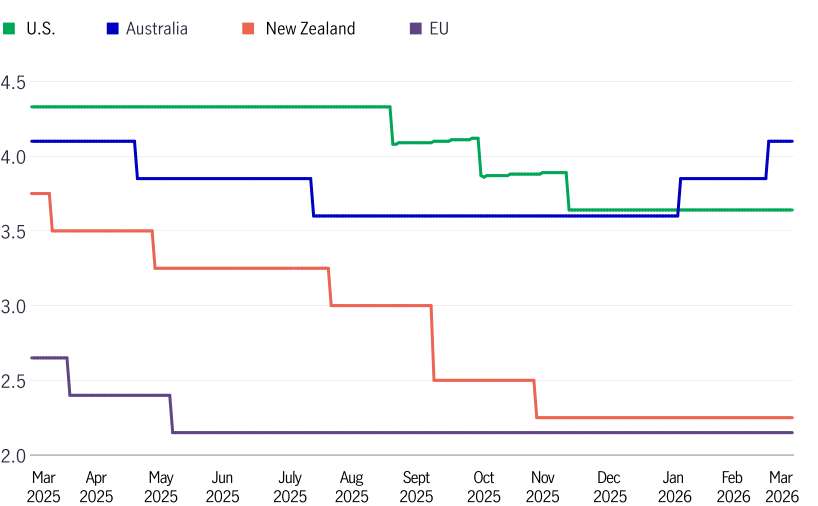
These interconnected forces are reshaping the fixed income landscape and redefining how capital is allocated. Rapid macro shifts and widening policy divergence demand disciplined interpretation and a readiness to capture opportunities without overreacting to noise. At the same time, rising geopolitical tensions introduce an additional source of potential volatility, particularly through energy markets and inflation expectations. For capital allocators, clarity in this environment will come from understanding how these forces interact—and from positioning portfolios to navigate complexity with balance and a global perspective.
Macro-to‑markets: investment ideas for 2026
As these macroeconomic forces continue to unfold, three clear portfolio ideas emerge for navigating the year ahead:
1 Tight credit spreads: the importance of staying selective
The bond market is flush with capital, with substantial liquidity still sitting on the sidelines. The corporate credit segment of the market remains well supported by investor demand, although recent volatility has led to modest widening in credit spreads across several sectors. While spreads remain relatively tight by historical standards, recent volatility serves as a reminder that valuations leave less margin for error and that dispersion across issuers, industry sectors, and qualities may increase as macro uncertainty evolves.
Tight credit spreads leave little room for error
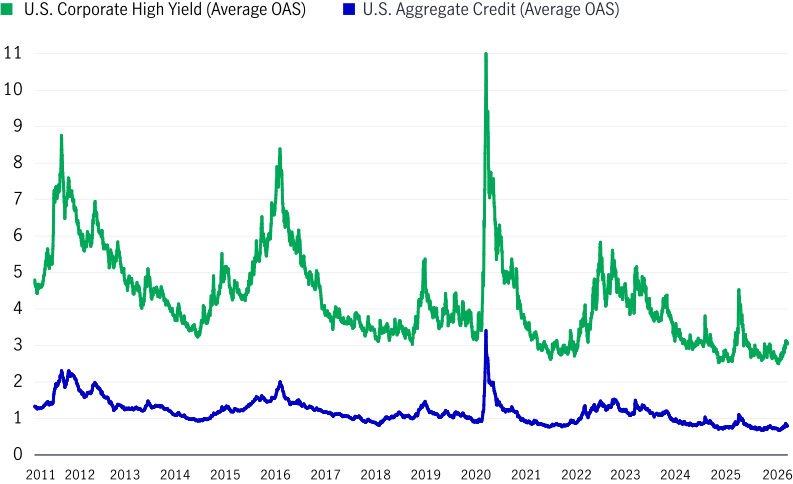
Within this context, an allocation to high yield corporate credit can still play a constructive role—but with enhanced emphasis on managing downside risks. Select investment grade credit opportunities, particularly among issuers with durable fundamentals and appealing structure, may offer more compelling compensation. The key is maintaining flexibility to scale exposure when the market provides more attractive entry points.
2 Go global: opportunities beyond the United States
Although the U.S. bond market remains a natural anchor for many institutions due to its depth and familiarity, opportunities across global and developed markets are expanding as policy and economic cycles diverge. Differences in inflation paths, fiscal priorities, and central bank strategies are creating a broader range of relative value opportunities across regions and sectors, including developed markets such as Australia and New Zealand, where distinct monetary policy trajectories and yield dynamics may offer attractive diversification benefits.
Recent performance illustrates why the opportunities outside the United States can be additive when cycles decouple. EM investment-grade sovereign hard-currency debt, for example, returned 10.0% in 2025, driven by about 30 basis points of spread tightening alongside a duration rally. Remaining overly home-biased risks narrowing investment opportunity at a time when attractive yields and divergent macro trajectories are appearing across both developed and emerging markets.
Today’s global environment supports a multi‑sector, multi‑currency framework, where institutions can achieve both return enhancement and diversification by capturing opportunities where local dynamics differ from those in the United States.
3 Currencies: getting the mix right
While a repeat of 2025’s broad U.S. dollar weakness is far from certain, its future path should remain volatile as geopolitical tensions and shifting global capital flows influence risk sentiment. In this environment, thoughtful currency exposure can provide incremental return potential and diversification for USD-based investors. Last year’s support came from a varied set of currencies, notably developed currencies including the Swedish krona and Euro, which benefited from improving confidence in Europe’s fiscal trajectory. Emerging foreign currencies also outperformed the USD over a similar period, mostly attributed to policy easing by the Federal Reserve. The Brazilian real, for instance, yielded a nearly 29% total return versus the USD over the twelve-month period due to differing interest rate and monetary policy profiles. Investors can complement USD holdings by calibrating FX exposures where currency fundamentals present a reasonable expected payoff. Governance and disciplined sizing, however, remain essential components of any currency allocation framework.
Building resilient portfolios for a more fragmented world
With macroeconomic forces evolving and policy divergence deepening, investors need to consider approaching global fixed income with a broader lens and a more tactical mindset. Broadening opportunity sets through a combination of selective high quality credit exposure, geographic diversification, and careful currency positioning can help ensure portfolios remain resilient and not overly dependent on any single market or macro narrative.
In this environment, investors may be better equipped to navigate changing conditions by combining global awareness, a disciplined process, and the flexibility to respond as circumstances evolve.
Important Disclosures
Investing involves risks, including the potential loss of principal. Financial markets are volatile and can fluctuate significantly in response to company, industry, political, regulatory, market, or economic developments. The information provided does not take into account the suitability, investment objectives, financial situation, or particular needs of any specific person.
All overviews and commentary are intended to be general in nature and for current interest. While helpful, these overviews are no substitute for professional tax, investment or legal advice. Clients and prospects should seek professional advice for their particular situation. Neither Manulife Wealth and Asset Management, nor any of its affiliates or representatives (collectively “Manulife WAM”) is providing tax, investment or legal advice.
This material is intended for the exclusive use of recipients in jurisdictions who are allowed to receive the material under their applicable law. The opinions expressed are those of the author(s) and are subject to change without notice. Our investment teams may hold different views and make different investment decisions. These opinions may not necessarily reflect the views of Manulife WAM. The information and/or analysis contained in this material has been compiled or arrived at from sources believed to be reliable, but Manulife WAM does not make any representation as to their accuracy, correctness, usefulness, or completeness and does not accept liability for any loss arising from the use of the information and/or analysis contained. The information in this material may contain projections or other forward-looking statements regarding future events, targets, management discipline, or other expectations, and is only current as of the date indicated. The information in this document, including statements concerning financial market trends, are based on current market conditions, which will fluctuate and may be superseded by subsequent market events or for other reasons. Manulife WAM disclaims any responsibility to update such information.
Manulife WAM shall not assume any liability or responsibility for any direct or indirect loss or damage or any other consequence of any person acting or not acting in reliance on the information contained here. This material was prepared solely for informational purposes, does not constitute a recommendation, professional advice, an offer or an invitation by or on behalf of Manulife WAM to any person to buy or sell any security or adopt any investment approach, and is no indication of trading intent in any fund or account managed by Manulife WAM. No investment strategy or risk management technique can guarantee returns or eliminate risk in any market environment. Diversification or asset allocation doesn’t guarantee a profit or protect against the risk of loss in any market. Unless otherwise specified, all data is sourced from Manulife WAM. Past performance does not guarantee future results.
This material has not been reviewed by, and is not registered with, any securities or other regulatory authority, and may, where appropriate, be distributed by Manulife WAM and its subsidiaries and affiliates. Manulife WAM is the global investment, financial advice, and retirement plan services segment of Manulife Financial Corporation.
© 2026 by Manulife Wealth and Asset Management. All rights reserved. The statements and opinions expressed in this article are those of the author. Manulife WAM cannot guarantee the accuracy or completeness of any statements or data.
5377242