



Class is in session: investment lessons for Fall 2026 and beyond
Co-Chief Investment Strategist Kevin Headland covers three key topics—"lessons," if you will—that he's encouraging investors to focus on as we enter the fall season.

As summer transitions to autumn, many investors refocus on their investment strategies and portfolios. Reflecting on 2026 so far, let’s recap what we've learned about the markets:
- A fourth consecutive year of double-digit stock returns would be a statistical outlier, but market momentum is a powerful force that could make it possible.
- An oil supply shock can benefit value stocks and the energy sector but weigh on bonds, as long as economic growth is strong enough to support higher energy prices.
- It’s been all about earnings, earnings, earnings, as robust corporate earnings growth has been an underappreciated driver of market returns this year.
With these lessons in the books, but still timely, what else should investors be thinking about in the coming months?
Economics 101: from resilience to expansion
For much of the past two years, economists have debated whether higher interest rates would push the economy into recession. Instead, the global economy has displayed remarkable resilience.
Today, however, we may be entering a new chapter.
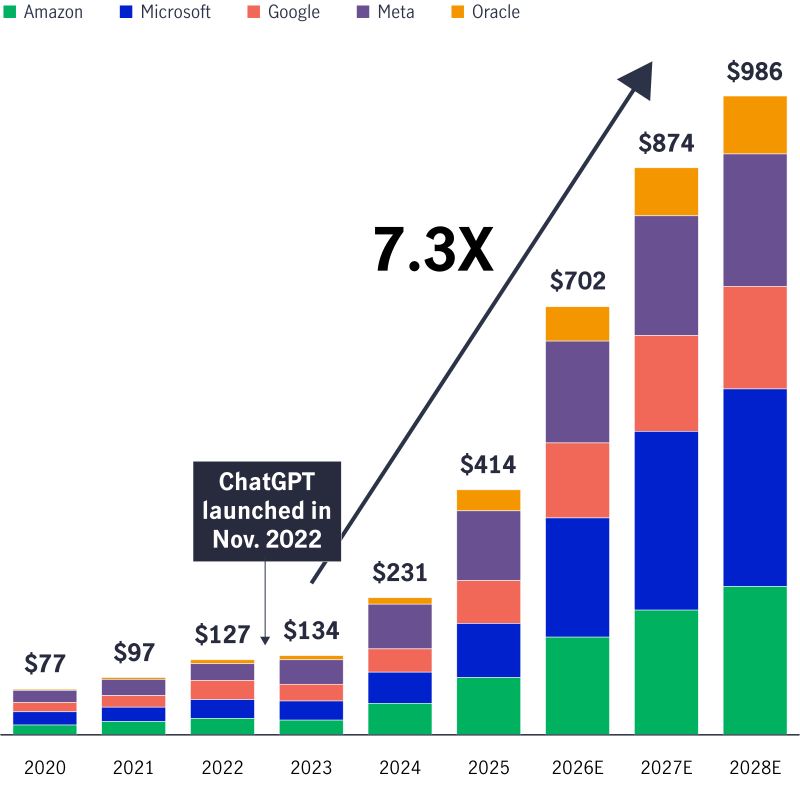
Looking across the global economy, several powerful forces are supporting growth. Governments continue to run large fiscal deficits. Defense spending is rising. The energy transition requires massive investment. One of the most significant developments has been the growing role of AI-related investment spending.
Hyperscalers and technology companies continue to spend hundreds of billions of dollars on data centres, semiconductors, networking equipment, power infrastructure, and cloud computing. These investments are propelling economic growth that extends well beyond technology, benefiting industrial companies, utilities, construction firms, and manufacturers.
Notably, these are not temporary cyclical trends. They are structural forces that could help fuel global economic activity for years, which highlights a crucial distinction. Many investors hear the words "higher inflation" and immediately think of stagflation, which is a combination of sluggish growth, weak productivity, and lofty inflation.
But that’s not what we're seeing. Instead, the global economy may be entering a period of what you might call a higher nominal growth regime, or perhaps "growth-flation," where growth remains reasonably solid, inflation settles above target, and interest rates stay higher for longer.
Consider where we are today. U.S. nominal GDP grew at a nearly 8% annualized rate between Q1 2026 and Q2 2026. That’s not a recessionary economy. In fact, it’s an economy generating substantial growth in incomes, revenues, and tax receipts.
Recent U.S. inflation data showed headline CPI rising 3.4% year-over-year, while core inflation, which strips out food and energy prices, remained relatively contained at 2.5%. At the same time, corporate earnings have generally continued to exceed expectations. Labor markets, while cooling, remain in decent shape overall.
So, in many ways, the global economy has graduated from simply surviving higher interest rates to harnessing new engines of growth.
Investors should not confuse this with boom-like conditions. Growth remains modest by historical standards. However, an environment characterized by moderate expansion, healthy earnings growth, and steadily easing inflation should remain supportive of risk assets.
Capex by U.S. cloud computing hyperscalers has skyrocketed (billion USD)
Geography: rethinking global diversification
Global equity diversification has traditionally meant just spreading assets across different countries and regions.
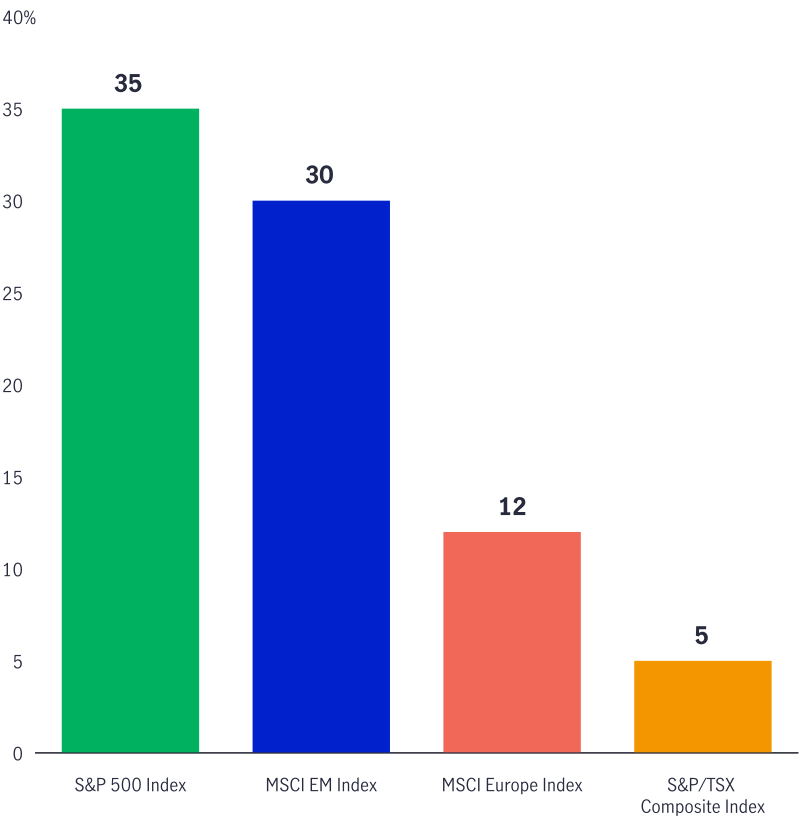
While geography still matters, today's market landscape suggests that investors should look deeper than simply where companies are headquartered. Overseas diversification is increasingly also about understanding economic exposures, sector compositions, and thematic concentrations.
Take emerging markets (EMs) as an example. One of the biggest structural changes in EMs over the past decade has been the gradual shift in index leadership from China-centric exposure toward a more technology-driven Taiwan and Korea concentration.
China remains the largest country in the MSCI Emerging Markets Index at roughly 29%, but its dominance has waned meaningfully from peak levels reached in the early 2020s, when investors viewed China as the primary EM growth story. Today, Taiwan and South Korea together account for nearly 30% of the index, effectively matching China's weight. More importantly, the largest individual stock positions in the index are no longer Chinese internet companies.
Historically, EM allocations offered investors exposure to different economic cycles, commodity production, manufacturing growth, and expanding consumer economies. Today, many of the largest EM indexes are heavily influenced by a handful of technology companies directly linked to the AI ecosystem.
This shift arguably makes the EM index less dependent on China’s domestic growth and more leveraged to global technology innovation, which has boosted recent EM equity performance. However, it has also magnified concentration risk around the semiconductor cycle. If AI-related capital spending were to slow, causing the semiconductor cycle to weaken, EM index returns could become vulnerable.
Thus, in many respects, EMs are now correlated with the global AI theme rather than serving as a diversified source of returns.
By contrast, developed markets such as Europe and Japan present a different set of opportunities.
European indexes tend to offer greater exposure to industrials, financials, healthcare, consumer goods, and global exporters. Japan provides exposure to automation, robotics, precision manufacturing, financial institutions, and corporate governance reform. Neither market is immune from technology trends, but both generally exhibit less concentration in AI-related stocks than many U.S. or EM benchmarks. The result is a potentially more balanced source of diversification.
This raises an important lesson for investors: Diversification should not be measured solely by the number of countries in a portfolio. Two markets may be located on opposite sides of the world, yet both might be closely tied to the same underlying macro theme.
The most relevant question may not be "Where am I invested," but rather, "What risks and opportunities am I exposed to?"
The U.S. and EM equity markets are increasingly concentrated in AI-related stocks
Math class: bonds are back, but with a twist
For years, fixed-income investing was fairly straightforward. Declining interest rates and muted inflation generally propped up bond prices, creating a favourable backdrop for investors seeking both income and capital appreciation.
Today's environment is different.
Long-term government bond yields have climbed toward levels not seen since before the global financial crisis (GFC). While higher market yields can augment the income stream available to bondholders, they also underscore what can be a painful reality for many fixed-income investors: When yields rise, bond prices fall.
For many investors, this mathematical relationship has worked against fixed-income returns over the last few years. The challenge facing markets today is that several factors may continue to keep long-term yields elevated.
While inflation has abated somewhat, it may prove stickier than many investors expect amid still-positive wage growth, firm services inflation, and ongoing business investment in AI infrastructure—data centres, semiconductor plants, and more—as well as other areas of the global economy.
Meanwhile, governments around the world continue to issue substantial amounts of debt to finance their spending programs and fiscal deficits. As bond supply increases, investors often demand higher yields.
In effect, bond investors may find themselves competing with governments and technology companies for the same pool of global savings.
The outcome could be structurally higher long-term yields than investors have become accustomed to since the GFC—a risk for existing bondholders but potentially appealing to income-oriented investors who can capitalize on the prevailing higher yields.
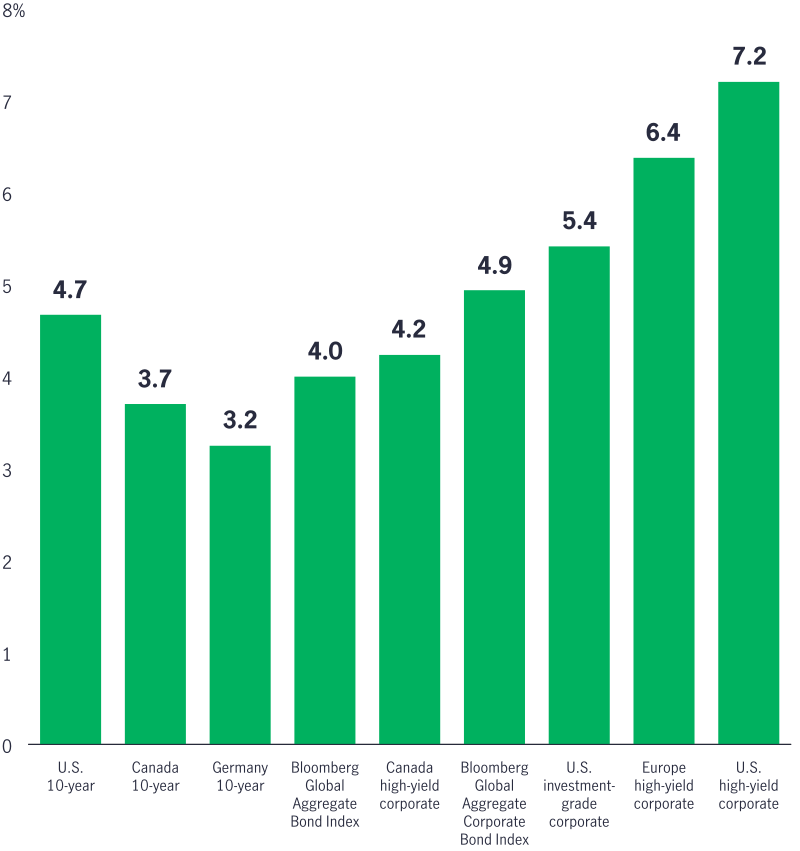
This evolving bond market leads to a key question: If government bond yields are approximately 5%, should investors automatically allocate capital there? Not necessarily.
A useful comparison here is between government debt yielding 5% and North American or European investment-grade corporate bonds featuring similar or even higher yields.
Although they often carry greater credit risk than government bonds, corporate bonds typically provide additional compensation in the form of a yield premium. Many corporates may offer attractive risk-adjusted return opportunities, particularly if company balance sheets remain healthy and economic growth continues.
Along with credit risk, investors should be mindful of interest-rate risk. That’s where active duration management comes in, carefully managing a bond portfolio’s rate sensitivity, while thoughtfully diversifying sources of return across market sectors and global regions.
Whether through North American corporate credit, European credit markets, or selectively positioned sovereign bonds, today’s fixed-income investors have access to a wider range of income-producing assets than at any point in the past decade.
Global bond yields: today's investors can access a range of income-producing assets
Final thought: be vigilant but opportunistic
From inflation data and earnings reports to central bank meetings and more, the rest of 2026 will be worth watching. Despite a slew of potential headwinds in the months ahead—economic, political, and geopolitical—we continue to believe that opportunities abound across both equity and fixed-income markets for investors willing to think globally and challenge conventional assumptions.
Important disclosures
Important disclosures
Investing involves risks, including the potential loss of principal. Financial markets are volatile and can fluctuate significantly in response to company, industry, political, regulatory, market, or economic developments.
The information provided does not take into account the suitability, investment objectives, financial situation, or particular needs of any specific person.
All overviews and commentary are intended to be general in nature and for current interest. While helpful, these overviews are no substitute for professional tax, investment or legal advice. Clients and prospects should seek professional advice for their particular situation. Neither Manulife Investments, nor any of its affiliates or representatives (collectively Manulife Investments” is providing tax, investment or legal advice.
This material is intended for the exclusive use of recipients in jurisdictions who are allowed to receive the material under their applicable law. The opinions expressed are those of the author(s) and are subject to change without notice. Our investment teams may hold different views and make different investment decisions. These opinions may not necessarily reflect the views of Manulife Investments. The information and/or analysis contained in this material has been compiled or arrived at from sources believed to be reliable, but Manulife Investments does not make any representation as to their accuracy, correctness, usefulness, or completeness and does not accept liability for any loss arising from the use of the information and/or analysis contained. The information in this material may contain projections or other forward-looking statements regarding future events, targets, management discipline, or other expectations, and is only current as of the date indicated. The information in this document, including statements concerning financial market trends, are based on current market conditions, which will fluctuate and may be superseded by subsequent market events or for other reasons. Manulife Investments disclaims any responsibility to update such information.
Manulife Investments shall not assume any liability or responsibility for any direct or indirect loss or damage or any other consequence of any person acting or not acting in reliance on the information contained here. This material was prepared solely for informational purposes, does not constitute a recommendation, professional advice,
an offer or an invitation by or on behalf of Manulife Investments to any person to buy or sell any security or adopt any investment approach, and is no indication of trading intent in any fund or account managed by Manulife Investments. No investment strategy or risk management technique can guarantee returns or eliminate risk in any market environment. Diversification or asset allocation does not guarantee a profit or protect against the risk of loss in any market. Unless otherwise specified, all data is sourced from Manulife Investments. Past performance does not guarantee future results.
This material has not been reviewed by, is not registered with any securities or other regulatory authority, and may, where appropriate, be distributed by Manulife Investment Management Limited. Manulife, Manulife & Design, Stylized M Design, and Manulife Investments are trademarks of The Manufacturers Life Insurance Company and are used by it and by its affiliates under license.
5893731 9/26